Runway conditions, reported right the first time.
Log serviceability checks and contaminant conditions from the field. OneReg brings your runway condition reporting into one auditable platform, turning inspection data into fast, accurate condition reports aligned with ICAO's Global Reporting Format.
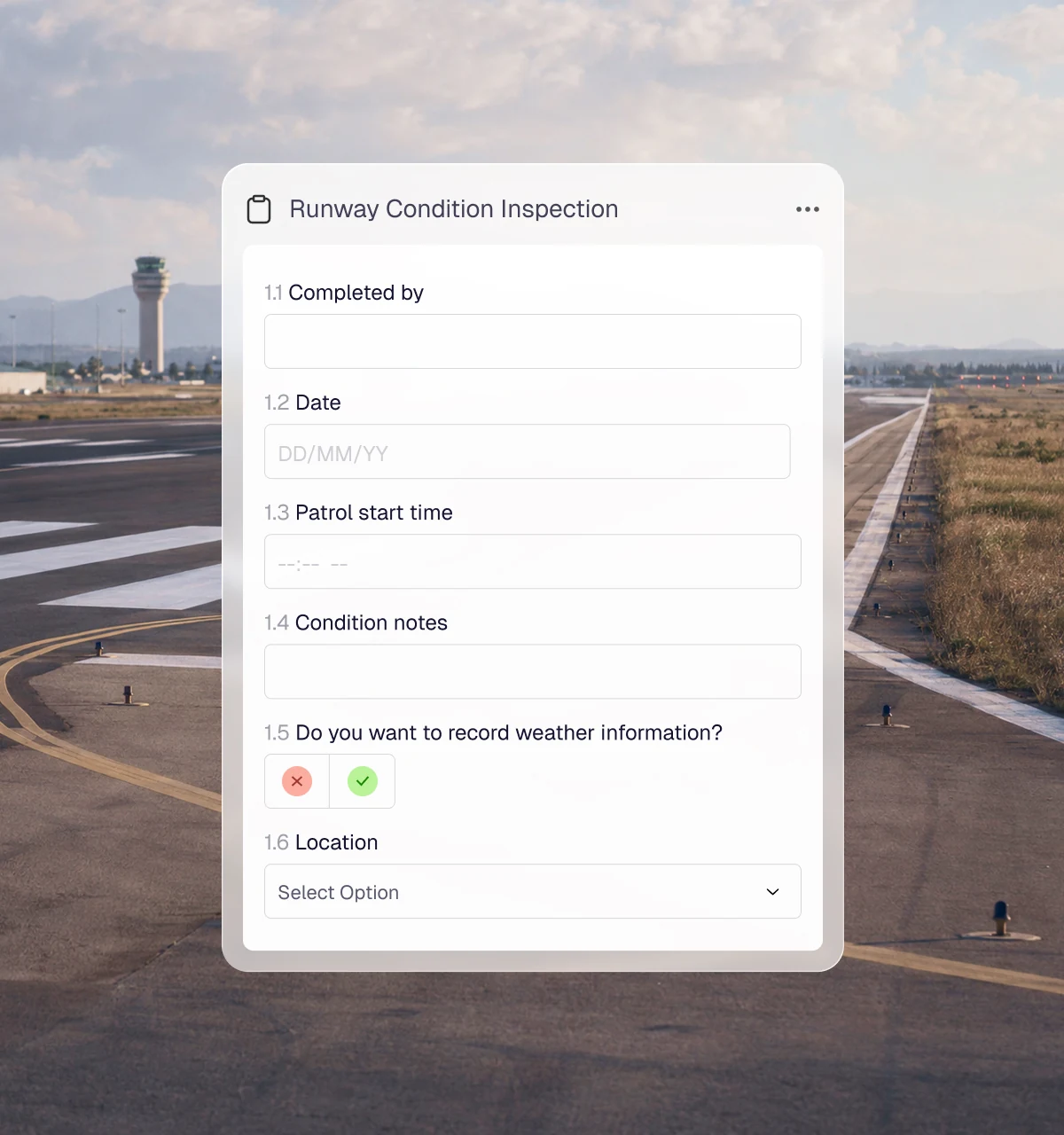
Runway condition reporting is one of the most time-critical tasks in airfield operations. A delayed or inaccurate report puts pilots making landing and take-off decisions at direct risk. Most teams still assess and communicate conditions through paper logs, radio calls, and manual re-entry into separate reporting systems, which slows distribution and leaves room for error. OneReg replaces that patchwork with a single system built for how airfield teams actually work: real-time inspections, condition assessment aligned with the Global Reporting Format, and reporting that your pilots and regulator can trust.
The runway condition challenges OneReg solves

Inconsistent field reporting
Capture serviceability checks and contaminant conditions the same way every time, from strip to apron, on any device. Standardised records mean nothing gets lost between the field and the tower.

Getting accurate data out fast
Assess and issue condition reports without re-keying data into a separate system, so pilots and ATC get current, reliable information without delay.

Risk you can't see across the season
Dashboard insights turn inspection logs into trend views and recurring problem-area heatmaps, so surfaces that need attention become visible before they become a hazard.

Everything your airfield team needs, in one place
Self-Inspections & Serviceability Checks
Log routine runway, taxiway, and apron inspections from a mobile device, on or off the airfield. Configurable checklists match your inspection schedule and frequency requirements.
Runway Condition Assessment & Reporting
Assess contaminant type, coverage, and depth by runway third and generate condition reports aligned with ICAO's Global Reporting Format and Runway Condition Assessment Matrix (RCAM), including Runway Condition Codes.
Contaminant & Weather Logging
Record contaminant type, coverage, depth, and relevant weather conditions at the point of inspection, building an accurate record of what was on the surface and when.
Fast, Consistent Distribution
Move assessed conditions into your reporting workflow without manual re-entry, reducing the time between inspection and distribution to pilots and air traffic control.
Heatmaps & Trend Dashboards
Visualise condition history by location, contaminant type, and season. Spot recurring problem areas like drainage issues, rubber build-up, and ice-prone sections before they become a bigger problem.
Audit-Ready Records
Every inspection and condition report is timestamped and stored centrally, so you can respond to an audit or regulatory request in minutes, not days. Any downgrading or upgrading decision is documented and evidenced.
Integrated with the Rest of Your Operation
Runway condition data lives alongside your Safety Management System, wildlife hazard records, risk register, and asset management — one platform, one source of truth.
Faster reports.
Safer surfaces.
- Cut the time between a runway inspection and an accurate report reaching pilots and ATC
- Replace paper logs and radio call re-entry with one consistent system across your whole team
- Spot recurring surface issues early enough to schedule maintenance before they become a hazard
- Walk into any audit with complete, linked, time-stamped runway inspection evidence
- Onboard new airfield staff faster with standardised, configurable inspection checklists

Hear it straight from the hangar
“Before OneReg, our compliance and safety reporting lived in multiple systems and spreadsheets. It was time-consuming, fragmented and difficult to trace. What used to take days now
takes minutes.”

Sam Merlo
Operations Compliance Coordinator
"OneReg has transformed our operational efficiency and compliance management. The user-friendly interface and proactive support from the OneReg team have been invaluable. We can now manage our data more effectively and ensure ongoing compliance with ease."

Chris Fox
Manager Safety & Quality Assurance
"Operational efficiency has been greatly enhanced - automation and integration of processes have reduced operational drag, allowing staff to focus on critical tasks. The system’s user-friendly interface has made it easier for staff to manage compliance activities efficiently."

Kim Gard
Operations Manager



Frequently asked questions
The GRF is the ICAO standard airports use to assess and report runway surface conditions consistently, using a Runway Condition Assessment Matrix and Runway Condition Codes so pilots receive comparable information regardless of location. OneReg supports the GRF by digitising the assessment at the point of inspection and carrying that data straight through into a standardised condition report, instead of relying on manual interpretation and re-entry.
Inspectors log contaminant type, coverage, and depth by runway third directly in OneReg, and the platform carries that data through to a structured condition report, cutting the time and manual steps between an inspection and a report going out.
Yes. Inspections capture contaminant details at the level of detail the GRF requires, so assessments are consistent regardless of who's carrying out the inspection.
Yes. Configurable checklists and schedules match your required self-inspection frequency, and completed inspections are timestamped automatically, giving you a clear record that checks were carried out on time.
OneReg is configurable to your regulator's runway condition and reporting requirements, whether that's based on ICAO's GRF or a national variation. Talk to our team about your specific framework so we can confirm exactly how OneReg maps to it.
Friction test results and other surface assessment data can be logged and linked to the relevant inspection and asset records, so condition history and equipment maintenance stay connected rather than living in separate files.
Yes. Inspections and condition assessments can be logged from a mobile device out on the airfield, so records are created at the point of observation rather than reconstructed later from notes or memory.
Every inspection, assessment, and report is timestamped and stored centrally, so you can produce a complete record for an audit or regulatory request in minutes rather than piecing one together from logs and paperwork.
Yes. Dashboards turn logged inspections into heatmaps and trend views by location and contaminant type, making it easier to spot recurring issues like drainage problems or ice-prone sections and plan maintenance proactively.
They share the same platform and data model, so a runway condition issue can be linked directly to a hazard entry, a procedural requirement, or an asset inspection without switching systems or re-entering information.
Invested in the future of aviation together